Wisdom & the Deep Teachings · 3rd century CE (Coptic copy c. mid-4th century)
The Hypostasis of the Archons
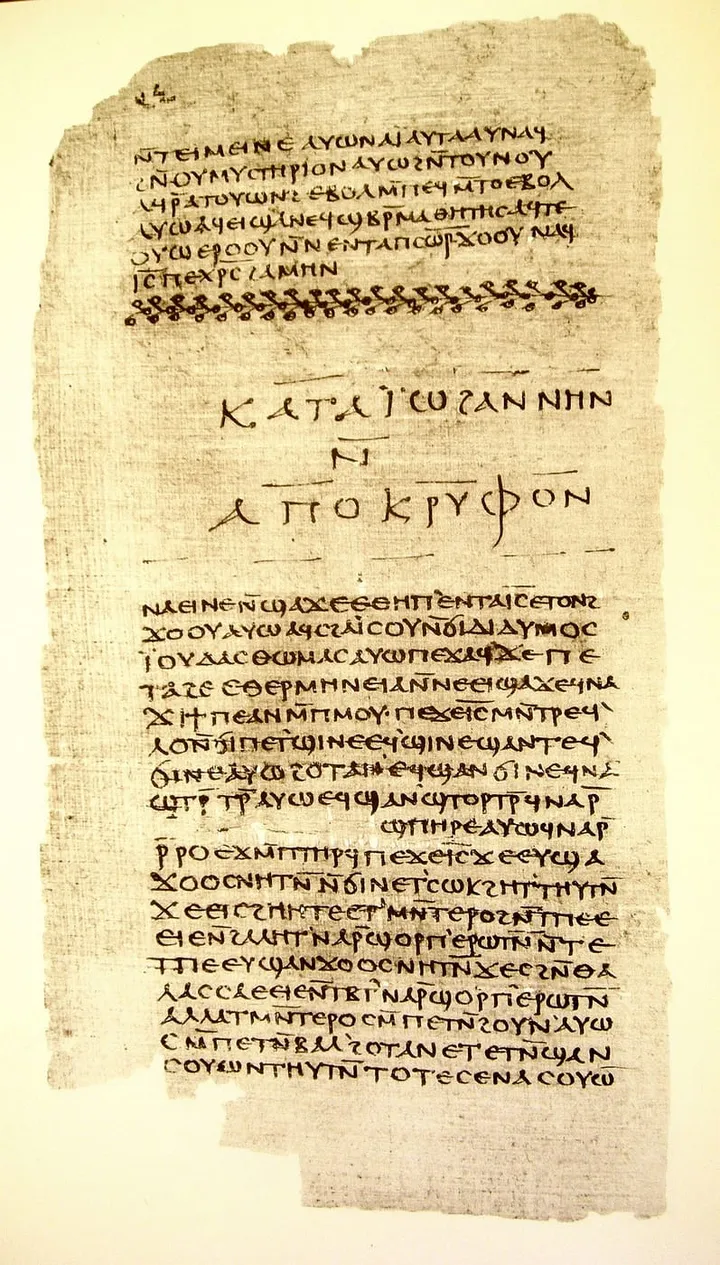
The Hypostasis of the Archons, 'The Reality of the Rulers', is a Gnostic retelling of Genesis 1–6 from Nag Hammadi Codex II, in which the world's rulers, led by the blind and arrogant Samael, mold Adam from dust, fail to catch the image of God in the waters, and are outwitted at every turn by the spirit-filled woman, the snake who is an instructor, and Norea, the daughter of Eve. In its second half the angel Eleleth explains to Norea where the rulers came from: Sophia's shadow, which became matter. It survives in one Coptic copy, pages 86–97 of the codex.
In the app:Reads offlineReading pathsAsk the LibraryPlain-English notesReads aloudHighlights & notesMy StudyDaily readingNo ads · no accountSee all features →
The text opens by quoting Paul, 'our struggle is not against flesh and blood, but against the authorities of the world and the spiritual things of wickedness' (Ephesians 6:12), and then tells you, as if answering a letter, what those authorities really are. What follows is the book of Genesis read upside down: the god who says 'I am God and there is no other' is a blind ruler called Samael; the deep sleep that falls on Adam is ignorance; the tree of knowledge is good; and the snake, for one scene, is the mouthpiece of the spirit who wants Adam and Eve to see.
Two women hold the story together. Eve, the 'spirit-filled woman', raises Adam from the ground with a word and escapes the rulers by turning into a tree, leaving only her shadow in their hands. Her daughter Norea, who is barely a footnote in other traditions, burns Noah's ark when he will not take her aboard, faces down the chief ruler when he tries to seduce her, and cries out to the God of the entirety. The great angel Eleleth comes down, and the second half of the book is his answer to her question: where did these rulers come from, and what are they made of?
His answer is the Gnostic creation story in miniature. Sophia, 'who is called Pistis', wanted to make something alone, without her consort; a shadow fell beneath the veil that separates the realms above from the realms below, and the shadow became matter. From it an arrogant, lion-faced being took shape, opened its eyes, and declared itself the only god. One of its sons, Sabaoth, repented when he heard the voice from above, and was lifted to the seventh heaven and seated on a chariot of cherubim; his father, seeing this, grew envious, and envy begot death. The children of the light, Eleleth tells Norea, are not from this matter at all, and after three generations the true man will come and anoint them with the ointment of eternal life.
The Coptic text survives in a single fourth-century copy, Nag Hammadi Codex II, pages 86–97, translated from a lost Greek original of the third century; the tops of several pages are damaged. This English rendering is The Gnostic Library's own, made from the photographs of the papyrus in the Claremont Colleges Library's Nag Hammadi Archive and labeled as a rendering, not a literal translation. Lost letters restored from context stand in square brackets; where the papyrus is gone, the gap is shown as a gap.
A living rendering. This English text is The Gnostic Library's own rendering from the Coptic, labeled as a rendering, not a literal translation. Every line traces to the manuscript cited above; gaps in the papyrus are shown in brackets, never filled.
NHC II 86,20–87,11The blind ruler
Concerning the reality of the authorities. In the spirit of the Father of truth, the great apostle told us about the authorities of the darkness: "Our struggle is not against flesh and blood, but against the authorities of the world and the spiritual things of wickedness." [I have] sent this to you because you ask about the reality of the authorities.
Their chief is blind. [Because of] his power and his ignorance [and his] arrogance he said, in his [power], "It is I who am God; there is no one [apart from me]." When he said this, he sinned against [the entirety]. And this word reached up to incorruptibility; and a voice came out of incorruptibility, saying, "You are wrong, Samael", which means "god of the blind."
His thoughts went blind. He cast out his power, that is, the blasphemy he had spoken, and pursued it down to chaos and the abyss, his mother, at the prompting of Pistis Sophia. And she set each of his offspring in place according to its power, after the pattern of the realms that are above; for it is from the hidden things that the visible things were found.
NHC II 87,11–88,10The image in the waters
The manuscript record
⟦ The lower right of page 87 and the first line of page 88 are damaged; the words in square brackets are restored from the sense. ⟧
Why is something missing or noted here? The ancient copy is damaged or incomplete at this point, or its editors left a note. It is shown rather than hidden, and nothing has been left out by The Gnostic Library.
Incorruptibility looked down into the regions of the waters. Her image appeared in the waters, and the authorities of the darkness fell in love with it. But they could not lay hold of that image which had appeared to them in the waters, because of their weakness, for beings of soul cannot lay hold of beings of spirit; they are from below, while it is from above. This is why incorruptibility looked down into the regions: so that, by the will of the Father, she might join the entirety to the light.
The rulers took counsel together. They said, "Come, let us make a man of dust from the earth." They molded their creature as one wholly of the earth. Now the rulers [have] bodies that are female [and] faces that are the faces of beasts. They took [dust] from the earth and molded [their man] after their own body and [after the image] of God which had appeared [to them] in the waters. They said, "[Come, let us] lay hold of it in our molded form, [so that] it may see its fellow-[likeness …] and we may seize it in our molded form", not understanding the power of God, because of their powerlessness.
And he breathed into his face, and the man became a being of soul upon the earth for many days. But they could not raise him up, because of their powerlessness. They persisted like storm winds, trying to catch that image which had appeared to them in the waters, and they did not understand what its power was.
Text is missing here. The ancient copy is damaged, lost or unreadable at this point, so the gap is shown as a gap. Nothing has been left out by The Gnostic Library.
NHC II 88,10–89,3Adam in the garden
The manuscript record
⟦ The left margin of page 88 is broken away from line 17 to the foot; the beginnings of those lines are restored in square brackets. ⟧
Why is something missing or noted here? The ancient copy is damaged or incomplete at this point, or its editors left a note. It is shown rather than hidden, and nothing has been left out by The Gnostic Library.
Now all these things came about by the will of the Father of the entirety. Afterwards the Spirit saw the man of soul upon the ground; and the Spirit came out of the adamantine land, came down and settled within him, and that man became a living soul. He called his name Adam, for he was found moving upon the ground.
A voice came out of incorruptibility for the help of Adam. And the rulers gathered together all the beasts of the earth and all the birds of the sky, and brought them in to Adam, to see what Adam would call them, that he might give a name to each of the birds and to all the beasts.
They took Adam [and put him] in the garden, to work [in it] and to keep it. And the rulers commanded him, saying, "From [every] tree that is in the garden you may eat; but [from] the tree of knowing good and evil do not eat, nor [touch] it; for on the day you eat [from] it, you shall surely die." They [did not understand what they] had said to him; rather, by the will of the Father they said it this way, so that he might eat, and so that Adam would reckon them to be wholly of matter.
NHC II 89,3–90,2The woman and the instructor
The manuscript record
⟦ The right edge of page 89 is damaged in its lower half; the ends of those lines are restored in square brackets. ⟧
Why is something missing or noted here? The ancient copy is damaged or incomplete at this point, or its editors left a note. It is shown rather than hidden, and nothing has been left out by The Gnostic Library.
The rulers took counsel with one another. They said, "Come, let us bring a deep sleep upon Adam." And he slept. Now the deep sleep is the ignorance which they brought upon him; and he slept. They opened his side, like a living woman, and they built up his side with flesh in her place; and Adam became wholly a being of soul.
The spirit-filled woman came to him and spoke with him. She said, "Rise, Adam." And when he saw her he said, "It is you who have given me life. You shall be called the Mother of the living, for she is my mother; she is the physician, and the woman, and she who has given birth."
Then the authorities came in to their Adam. When they saw his female counterpart speaking with him, they were stirred with a great stirring, and they desired her. They said to one another, "Come, let us cast our seed into her." They pursued her; and she laughed at them for their senselessness and their blindness. In their hands she became a tree, and she left her shadow-likeness beside them, resembling her. And they defiled [it] foully; and they defiled the seal of her voice, so that they condemned themselves in their own molded form and [their] image.
Then the spirit-filled one came [in] the snake, the instructor, and it taught [them], saying, "What did [he say to] you? 'From every tree [in the] garden you may eat, [but from the tree of] knowing evil and good, do not eat'?"
NHC II 90,2–91,11The tree and the curse
The manuscript record
⟦ The lower left of page 90 and the first line of page 91 are damaged; the words in square brackets are restored from the sense. ⟧
Why is something missing or noted here? The ancient copy is damaged or incomplete at this point, or its editors left a note. It is shown rather than hidden, and nothing has been left out by The Gnostic Library.
The woman of flesh said, "Not only did he say 'Do not eat', but 'Do not touch it; for on the day you eat from it, you will die.'" And the snake, the instructor, said, "You will not die. He said this to you because he is envious. Rather, your eyes will be opened and you will become like the gods, knowing evil and good." And the instructor was taken away from the snake, and she left it behind, a mere thing of earth.
The woman of flesh took from the tree; she ate, and she gave to her husband with her as well; and the beings of soul ate. And their wickedness opened out of their ignorance, and they realized that they were stripped of the spiritual. They took fig leaves and tied them around their loins.
Then the great ruler came and said, "Adam, where are you?" for he did not understand what had happened. And Adam said, "I heard your voice and I was afraid, because I was naked; and I hid." The ruler said, "Why did you hide, unless you have eaten from the tree I commanded you about, 'From it alone do not eat'; and you ate?" Adam said, "The woman you gave me, [she] gave to me and I ate." And the arrogant ruler cursed the woman. The woman said, "[It was] the snake that led me astray, and I ate." [They turned to the snake] and cursed its shadow-likeness, [… power]less, not knowing [that it was] a molded form of their own. From that day on [the snake] has been under the curse of the authorities; until the perfect man should come, that curse came upon the snake.
They turned to their Adam, took him and threw him out of the garden together with his wife, for there is no blessing in them, since they too are under the curse. And they threw mankind down into great distraction and into the pains of life, so that their people might be taken up with the business of living and have no leisure to be devoted to the holy Spirit.
Text is missing here. The ancient copy is damaged, lost or unreadable at this point, so the gap is shown as a gap. Nothing has been left out by The Gnostic Library.
NHC II 91,11–92,3Cain, Abel, Seth and Norea
The manuscript record
⟦ The right edge of page 91 is broken away in its lower third, and the top of page 92 is lost; the words in square brackets are restored from the sense. ⟧
Why is something missing or noted here? The ancient copy is damaged or incomplete at this point, or its editors left a note. It is shown rather than hidden, and nothing has been left out by The Gnostic Library.
After these things she bore Cain, their son; and Cain worked the earth. Again he knew his wife; she conceived again and bore Abel; and Abel was a keeper of sheep. Cain brought in [the] fruits of his field, but Abel brought in an offering from his lambs. God looked upon the gifts of Abel, but he did not accept the gifts of Cain. And Cain, the man of flesh, pursued Abel his brother.
And God said to Cain, "Where is Abel your brother?" He answered and said, "Am I my brother's keeper?" God said to Cain, "Listen: the voice of your brother's blood cries out to me. You have sinned [with your] mouth. It will return upon you. Anyone who kills Cain will let loose [seven] vengeances; and you will go about groaning and trembling upon the earth."
And [Adam knew] his female counterpart Eve; she conceived and bore [Seth] to Adam. And she said, "I have borne [another] man through God, in place [of Abel]." Again Eve conceived and bore [Norea]; and she said, "He has begotten for [me a virgin as a help …] for many generations of mankind." She is the virgin whom the powers did not defile.
Text is missing here. The ancient copy is damaged, lost or unreadable at this point, so the gap is shown as a gap. Nothing has been left out by The Gnostic Library.
NHC II 92,3–93,2Norea and the ark
The manuscript record
⟦ The lower left of page 92 is damaged; the words in square brackets are restored from the sense. ⟧
Why is something missing or noted here? The ancient copy is damaged or incomplete at this point, or its editors left a note. It is shown rather than hidden, and nothing has been left out by The Gnostic Library.
Then mankind began to multiply and to improve. The rulers took counsel with one another and said, "Come, let us make a flood with our hands and wipe out all flesh, from man to beast." But when the ruler of the powers learned of their plan, he said to Noah, "Make yourself an ark from wood that does not rot, and hide in it, you and your children and the beasts and the birds of the sky, from small to great, and set it upon Mount Sir."
Then Norea came to him, wanting to go up into the ark; and when he would not let her, she blew upon the ark and made it burn. Again he made the ark, a second time.
The rulers went to meet her, wanting to lead her astray. Their chief said to her, "Your mother Eve came to us." But Norea turned to them and said to them, "It is you who are the rulers of the darkness; you are accursed. You did not know my mother; rather, it was your own female counterpart that you knew. For I am not from you; I have come from the realms above."
The arrogant ruler turned, with all his might, [and] his face became like [black fire]; he dared to come up against her. [He said] to her, "You must serve us, [as] your mother Eve also did; for I have been given [...]." But Norea turned, with the power of [...]; she cried out with a loud voice [up to] the holy one, the God of the entirety: "Help me against the rulers of unrighteousness, and save me out of their hands, at once!"
Text is missing here. The ancient copy is damaged, lost or unreadable at this point, so the gap is shown as a gap. Nothing has been left out by The Gnostic Library.
NHC II 93,2–94,2Eleleth, the great angel
The manuscript record
⟦ The right edge of page 93 is broken away in its last lines, and the top of page 94 is lost; the words in square brackets are restored from the sense. ⟧
Why is something missing or noted here? The ancient copy is damaged or incomplete at this point, or its editors left a note. It is shown rather than hidden, and nothing has been left out by The Gnostic Library.
The angel came down out of the heavens and said to her, "Why are you crying up to God? Why are you so bold toward the holy Spirit?" Norea said, "Who are you?" for the rulers of unrighteousness had withdrawn from her. He said, "It is I who am Eleleth, understanding, the great angel who stands in the presence of the holy Spirit. I have been sent to speak with you and to save you out of the hands of the lawless ones; and I will teach you about your root."
Now as for that angel, I cannot describe his power. His appearance is like fine gold, and his garment like snow; truly my mouth cannot bear to describe his power and the look of his face.
Eleleth, the great angel, spoke to me. "It is I," he said, "who am understanding. I am one of the four light-bearers who stand in the presence of the great invisible Spirit. Do you think that these rulers have any power over you? None of them can overcome the root of truth; for on its account he appeared in the last times, and these authorities will be restrained. And these authorities cannot defile you and that generation; for your dwelling is in incorruptibility, where the virgin Spirit dwells, who is above the authorities of chaos and above their world."
But I said, "Lord, teach me about [the power of] these authorities, how did they come into being, and from what reality, and from what matter, [and who produced them …] with their power?"
Text is missing here. The ancient copy is damaged, lost or unreadable at this point, so the gap is shown as a gap. Nothing has been left out by The Gnostic Library.
NHC II 94,2–95,13Sophia's shadow becomes matter
The manuscript record
⟦ The right edge of page 94 is damaged towards the foot, and the first line of page 95 is broken; the words in square brackets are restored from the sense. ⟧
Why is something missing or noted here? The ancient copy is damaged or incomplete at this point, or its editors left a note. It is shown rather than hidden, and nothing has been left out by The Gnostic Library.
And the great angel Eleleth, understanding, said to me: "Within the limitless realms is incorruptibility. Sophia, who is called Pistis, wanted to create something alone, without her consort; and her product became a thing of heaven. A veil exists between the realms above and the realms below; and a shadow came to be beneath the veil, and that shadow became matter; and that shadow was cast aside, apart. And what she had produced became a work in matter, like an untimely birth. It took its shape from the shadow and became an arrogant beast, in the likeness of a lion. It was male-and-female, as I have said before, because it came from matter.
"It opened its eyes and saw a vast, limitless matter; and it grew arrogant, saying, 'It is I who am God, and there is no other apart from me.' When it said this, it sinned against the entirety. And a voice came from above the realm of absolute power, saying, 'You are wrong, Samael', that is, 'the blind god'. And he said, 'If anything exists before me, let it appear to me!' And at once Sophia stretched out her finger and brought light into matter, and she pursued it down to the regions of chaos; and she withdrew [up to] her light. Once more darkness [… in] matter.
"This ruler, being male-and-female, [made] himself a great realm, a greatness [without] limit. He thought of making children for himself; and he made seven children for himself, male-and-female like their father. And he said to his children, 'It is I who am the god of the entirety.' And Zoe, the daughter of Pistis Sophia, cried out and said to him, 'You are wrong, Sakla!' whose other name is Ialdabaoth. She breathed into his face, and her breath became for her an angel of fire; and that angel bound Ialdabaoth and threw him down into Tartaros, beneath the abyss.
Text is missing here. The ancient copy is damaged, lost or unreadable at this point, so the gap is shown as a gap. Nothing has been left out by The Gnostic Library.
NHC II 95,13–96,3The repentance of Sabaoth
The manuscript record
⟦ The lower right of page 95 and the first lines of page 96 are damaged; the words in square brackets are restored from the sense. ⟧
Why is something missing or noted here? The ancient copy is damaged or incomplete at this point, or its editors left a note. It is shown rather than hidden, and nothing has been left out by The Gnostic Library.
"Now when his son Sabaoth saw the power of that angel, he repented; he condemned his father and his mother, matter. He loathed her; and he sang hymns up to Sophia and her daughter Zoe. And Sophia and Zoe lifted him up and set him over the seventh heaven, below the veil between the above and the below. And he was called 'the God of the powers, Sabaoth', because he is above the powers of chaos, for Sophia set him there.
"Then, when these things had happened, he made himself a great chariot of cherubim, with four faces, and angels without number to serve him, and harps and lyres. And Sophia took her daughter Zoe and seated her at his right hand, to teach him about the things that exist [in the] eighth; and the angel [of wrath she] set at his left. [Since that] day, [his right] has been called Life, and the left has come to stand for the unrighteousness of the realm of absolute power above; they came into being before [him].
NHC II 96,3–96,17Envy begets death
"Now when Ialdabaoth saw him in this great glory and at this height, he envied him; and the envy became a work that was male-and-female, and this was the origin of envy. And envy begot death; and death begot its children and set each of them over its own heaven; and all the heavens of chaos became full of their multitudes. But all these things came about by the will of the Father of the entirety, after the pattern of all the things above, so that the number of chaos might be complete.
"There, I have taught you about the pattern of the rulers, and about the matter in which it was born, and their father, and their world."
NHC II 96,17–97,23The children of the light
The manuscript record
⟦ The lower left of page 96 and the first lines of page 97 are damaged; the words in square brackets are restored from the sense. The text ends with its title, 'The Hypostasis of the Archons'. ⟧
Why is something missing or noted here? The ancient copy is damaged or incomplete at this point, or its editors left a note. It is shown rather than hidden, and nothing has been left out by The Gnostic Library.
But I said, "Lord, am I also from their matter?"
"You, together with your children, belong to the Father who is from the beginning. Their souls come from above, out of the incorruptible light. For this reason the authorities cannot approach them, because of the Spirit of truth that dwells within them; and all who have come to know this way are immortal in the midst of dying humankind. But that seed will not appear now; rather, after three generations it will appear, and it will cast off from them the bond of the authorities' error."
Then I said, "Lord, how much longer?" He said to me, "Until the true man, out of a molded form, [reveals …] the one whom the Father has sent [… to teach them] about everything; and he will anoint them with the ointment of eternal life, which was given him from the generation that has no king. Then they will be set free from blind thought; they will trample underfoot the death that comes from the authorities; and they will go up into the limitless light, where this seed belongs.
"Then the authorities will leave their ages behind, and their angels will weep over their destruction, and their demons will mourn their death. Then all the children of the light will truly know the truth, and their root, and the Father of the entirety, and the holy Spirit. They will all say with a single voice: 'Righteous is the truth of the Father, and the Son is over the entirety', and from everyone, for ever and ever: 'Holy, holy, holy! Amen.'"
The Hypostasis of the Archons.
Text is missing here. The ancient copy is damaged, lost or unreadable at this point, so the gap is shown as a gap. Nothing has been left out by The Gnostic Library.
A living rendering by The Gnostic Library, from the Coptic of NHC II,4, read from the Claremont Colleges Library's photographs of the papyrus. Source: Nag Hammadi Codex II,4 (pages 86,20–97,23); the only surviving copy. Gaps and brackets reproduce the state of the source: nothing has been smoothed over or invented. Read about our standards on the sources & standards page.
Cite this page: “The Hypostasis of the Archons,” trans. The Gnostic Library, The Gnostic Library, thegnosticlibrary.com/texts/hypostasis-of-the-archons/ (updated 2026-10-11).
Common questions
What does 'Hypostasis of the Archons' mean?
'Hypostasis' is Greek for the underlying reality or substance of something; 'archons' are rulers. The Coptic title at the end of the text is 'The Hypostasis of the Archons', so the whole book is an answer to the question of what the world's rulers really are and where they came from.
Who is Samael?
The chief ruler, the blind and arrogant creator who boasts that he alone is God. The text glosses the name as 'god of the blind' and later calls him Ialdabaoth; in the Secret Book of John the same figure is the lion-faced Yaldabaoth, child of Sophia.
Who is Norea?
The daughter of Eve, born after Seth, 'the virgin whom the powers did not defile'. In this text she sets Noah's ark on fire, rebukes the rulers of darkness to their faces, and receives the revelation from the angel Eleleth. A short separate text in the same library, the Thought of Norea, is devoted to her.
Why is the snake a good figure here?
Because the spirit-filled woman enters the snake to become 'the instructor', telling Adam and Eve that the ruler forbade the tree out of envy and that eating from it will open their eyes. Once the teaching is given, the spirit leaves the snake, which is cursed and left 'a mere thing of earth'.
Is this translation complete?
Yes: pages 86,20 to 97,23 of the codex, everything that survives. The beginnings of a few pages (87, 92, 94, 96, 97) are damaged; those lines are marked as lost rather than silently filled.